

About the project
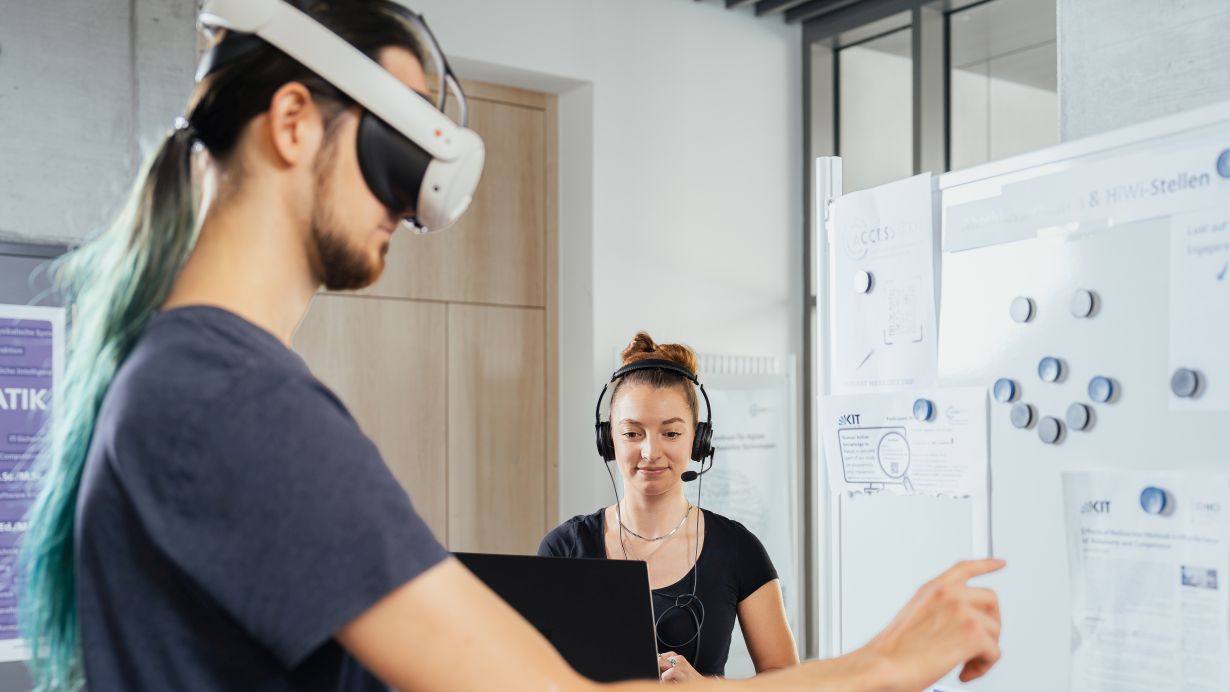
People with visual impairments rarely fail in their careers due to a lack of qualifications. The obstacle is usually their environment: reading a device label, deciphering a handwritten note, finding their way around unfamiliar rooms. Such tasks take time or require help from others. Classic assistive devices are strongly tailored to screen-based workstations and reach their limits wherever the work actually takes place.
This is exactly where AssistiveXR4Work comes in. We are developing a mobile assistance system that automatically recognizes visual information, magnifies it, displays it with higher contrast, or reads it aloud – while adapting to the individual visual needs of its users.
How the system works
The foundation is modern XR glasses with high-resolution cameras. They continuously capture the environment, and the image is digitally processed before it appears in the user's field of view: contrasts are enhanced, content is magnified, texts are recognized, and read aloud on request.
An integrated AI complements this image processing. It supports orientation, recognizes objects in the surroundings, and highlights relevant components. If this is not sufficient in a particular case, a sighted person can be brought in via livestream to provide direct assistance.
Application examples
-
In meetings: Content on a whiteboard is automatically recognized and magnified, handwritten notes are transcribed into plain text, and can be processed directly.
-
In technical work environments: The system supports orientation in the space and highlights the components that are currently relevant.
-
On the move within a facility: Labels, displays, and signage are made readable without having to take out a separate assistive device.
Inclusion meets skilled labor retention
The project improves participation in working life while also addressing the shortage of skilled workers. Many qualified employees lose their jobs or have to change their field of work when their eyesight deteriorates.
According to the Institute for Employment Research (IAB), a research institution of the Federal Employment Agency, severe disabilities are widespread in Germany and largely arise only in the course of working life. The probability of those affected still being employed five years later is roughly 16 percentage points lower. AssistiveXR4Work aims to help them continue practicing their profession.
Project framework
AssistiveXR4Work is a joint project of the Karlsruhe Institute of Technology (KIT) and the Fraunhofer Institute of Optronics, System Technologies and Image Exploitation IOSB. At KIT, the Center for Digital Accessibility and Assistive Technologies (ACCESS@KIT) is involved.
Over the next four years, a functional demonstrator will be developed, which will then be tested in practice. AssistiveXR4Work is the successor project of InclusiveVR@Work and builds on its results.
The project is funded by the Federal Ministry of Labour and Social Affairs with around 1.5 million euros.
Frequently asked questions
What is XR?
XR stands for Extended Reality and is an umbrella term for Virtual, Augmented, and Mixed Reality – in other words, technologies that combine real and digital content. For our project, so-called video passthrough is particularly relevant: cameras on the glasses capture the environment, the image is processed in real time, and output on displays directly in front of the eyes. Because the image passes through the computer, the real environment can be digitally modified instead of merely overlaying additional content.
Why visual assistance for people with visual impairments?
Visual impairment rarely means complete blindness. Most of those affected have usable residual vision. Purposefully supporting this vision – through magnification, enhanced contrasts, or highlighting important areas of the image – is often faster and more intuitive than translating all information into speech. Text-to-speech therefore remains a supplement, taking effect where vision alone is not enough.
What kind of visual impairment is supported?
There is a wide variety of different visual impairments. They can affect the visual field, color perception, or visual acuity, among other things. Due to this great variance, the predecessor project InclusiveVR@Work already showed that a high degree of adaptability of the system is more sensible than focusing on individual impairments or symptoms.
What hardware is being used?
Currently, we are working primarily with the Meta Quest 3. Over the course of the project, we will probably switch to newer glasses. Since the development is based on Unity and OpenXR, we are largely device-independent and do not have to commit to a single model.
Further information can be found in the official KIT press release.